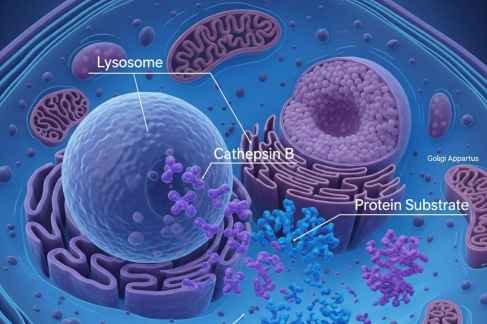
Lysosomes are essential organelles responsible for the degradation and recycling of cellular waste, damaged proteins, and foreign material. They maintain cellular homeostasis through a tightly regulated system of acidic hydrolases. Among these enzymes, cathepsins play a central role in proteolysis.
One of the most extensively studied is Cathepsin B, a lysosomal cysteine protease involved in protein turnover, apoptosis, and disease progression. Recombinant rat Cathepsin B has become a valuable tool in biomedical research, enabling scientists to study lysosomal activity under controlled and reproducible conditions.
Understanding Cathepsin B and Its Biological Role
Cathepsin B is a lysosomal endopeptidase and exopeptidase belonging to the papain-like cysteine protease family. It is predominantly active in acidic environments, such as those found in lysosomes. Within cells, Cathepsin B participates in the breakdown of intracellular proteins into smaller peptides and amino acids, which can then be recycled for new cellular functions.
Beyond its housekeeping role, Cathepsin B is implicated in several physiological and pathological processes. It contributes to antigen processing in immune responses, extracellular matrix remodeling, and programmed cell death. However, dysregulated Cathepsin B activity has been linked to diseases such as cancer, neurodegeneration, and inflammatory disorders. Understanding its precise function in lysosomal pathways is therefore critical for both basic and translational research.
What Is Recombinant Rat Cathepsin B?
Recombinant rat Cathepsin B is a laboratory-produced version of the naturally occurring enzyme found in rats. It is typically expressed in controlled systems such as bacterial, yeast, or mammalian cell lines, followed by purification to obtain an active and structurally consistent protein.
The recombinant form offers several advantages over native enzyme extraction from tissues. It provides high purity, batch-to-batch consistency, and the ability to produce large quantities without biological variability. Additionally, researchers can introduce specific modifications or tags to study enzyme structure, function, or interaction with inhibitors.
Rat Cathepsin B is often chosen due to its close physiological similarity to human Cathepsin B, making it a reliable model for preclinical studies.
Role in Studying Lysosomal Activity
Recombinant rat Cathepsin B is widely used to investigate lysosomal function under both physiological and pathological conditions. It is commonly employed in enzymatic activity assays to measure proteolytic activity within lysosomes and to evaluate how different conditions influence enzyme performance.
By introducing recombinant enzyme into experimental systems, researchers can simulate lysosomal degradation pathways and assess how factors such as pH, inhibitors, or cellular stress affect protease activity. This makes it a powerful model for studying intracellular protein turnover.
It also serves as an important indicator of lysosomal membrane integrity. When lysosomes are damaged, Cathepsin B can leak into the cytosol, where it may trigger inflammatory responses or apoptosis. Monitoring its activity therefore provides valuable insights into cellular health and lysosomal stability.
The use of recombinant rat Cathepsin B in lysosomal function studies has significantly improved the accuracy and reproducibility of lysosome-related experimental research, especially in controlled in vitro systems.
Applications in Disease Research
Recombinant rat Cathepsin B is particularly valuable in disease modeling. In cancer research, elevated Cathepsin B levels are associated with tumor invasion and metastasis. The enzyme contributes to the degradation of extracellular matrix components, allowing cancer cells to spread. By using recombinant enzyme systems, researchers can screen inhibitors that may reduce tumor progression.
In neurodegenerative diseases such as Alzheimer’s and Parkinson’s, lysosomal dysfunction is a key pathological feature. Cathepsin B is involved in the breakdown of misfolded proteins, including amyloid-beta peptides. Studying recombinant Cathepsin B helps scientists understand whether enhancing or inhibiting its activity could modify disease progression.
Additionally, in inflammatory conditions, Cathepsin B plays a role in activating cytokines and modulating immune responses. Recombinant protein systems enable controlled studies of these processes, helping identify potential therapeutic targets.
Role in Drug Discovery and Inhibitor Screening
One of the most important uses of recombinant rat Cathepsin B is in drug discovery. Because the enzyme is involved in multiple disease pathways, it is a key target for therapeutic intervention. Researchers use recombinant Cathepsin B in high-throughput screening assays to test potential inhibitors.
These assays measure how different compounds affect enzyme activity under standardized conditions. The recombinant system ensures reproducibility, making it easier to identify promising drug candidates. Inhibitors of Cathepsin B are being explored for cancer therapy, neuroprotection, and anti-inflammatory treatments.
Advantages in Experimental Research
The use of recombinant rat Cathepsin B provides several experimental advantages. First, it ensures high reproducibility across experiments, which is essential for generating reliable data. Second, it eliminates variability associated with tissue-derived enzymes. Third, it allows precise control over enzyme concentration and activity, enabling more accurate kinetic studies.
Researchers can also use recombinant forms to study enzyme structure through crystallography or spectroscopy. This helps in understanding active site mechanisms and designing more specific inhibitors.
Limitations and Considerations
Despite its advantages, recombinant Cathepsin B has some limitations. It may lack certain post-translational modifications present in native lysosomal environments, which can influence activity. Additionally, in vitro conditions cannot fully replicate the complexity of intracellular lysosomal systems.
Therefore, results obtained using recombinant enzymes are often complemented with cell-based or in vivo studies to validate findings.
Conclusion
Recombinant rat Cathepsin B is a powerful research tool that has significantly advanced the study of lysosomal activity. Its role in protein degradation, cellular regulation, and disease progression makes it a key enzyme in biomedical research. By providing a consistent and controllable system, it enables detailed investigation into lysosomal function and dysfunction.
From basic biochemical assays to advanced drug discovery applications, recombinant Cathepsin B continues to support a wide range of scientific studies. Its contribution is especially important in understanding complex diseases where lysosomal impairment plays a central role, ultimately helping guide the development of targeted therapies.
If you want to buy recombinant Cathepsin B proteins for lysosomal studies, you can rely on MyBioSource. For more information, visit the site.